A hand of Texas Hold’em is played in four stages: preflop, flop, turn and river. The Skill Poker Index measure three of them. This is not an oversight: it follows from how the model works, and understanding why the river is left out is the quickest way to understand what the other three do. Because the four stages of a poker hand are not four identical moments following one another. They are four different operations, and the player asks something different of each one.
One premise the model takes as given: the indices only come into play when someone moves all-in. If the hand develops all the way on its own, nothing changes compared with poker as it has always been played. What follows therefore describes two things at once: what each stage makes available to the player, and what the model recognises when the hand is cut short.
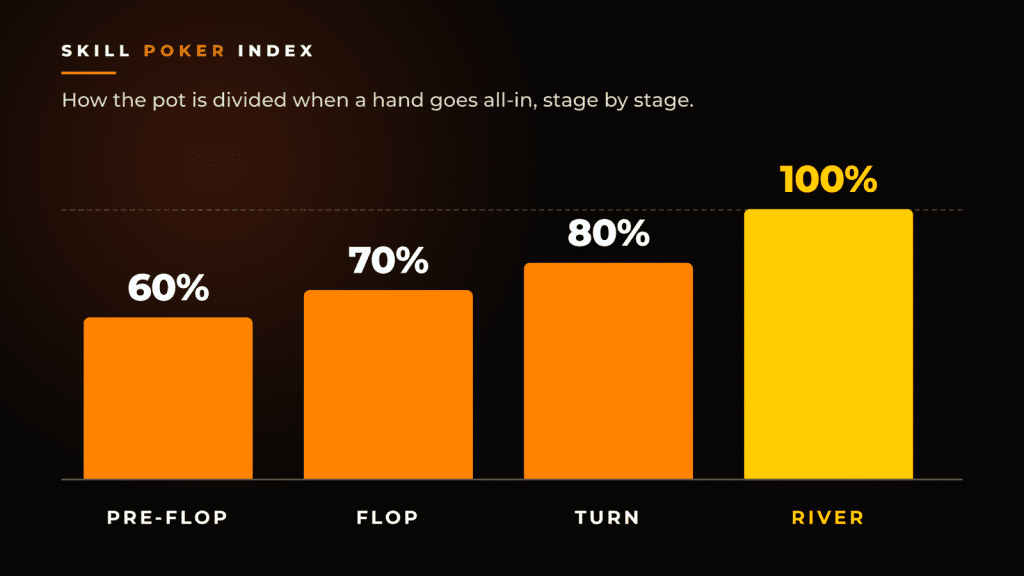
The general framework — what an index measures, the two factors it is born from, the matryoshka effect by which each stage contains the previous one, and why the published values are 60, 70 and 80 — has already been set out. Here we go one level deeper: inside the individual stages, one by one, as the theory of completeness of information had promised.
- Preflop: classifying the opponents
- Flop: the semantic narrowing of the range
- Turn: defining the situation
- River: correcting or confirming
Preflop: classifying the opponents
At the opening of the hand very little is known. Only two pieces of information are available: your own hole cards, and which opponents have shown interest in the pot. Nothing else. The board is empty, and no community card has yet been dealt.
Little, however, does not mean nothing. Those who observe well can already set effective lines of play on that little: who entered, from which position, at what pace. This is exactly the work that gives the stage its name — classifying who is sitting opposite. And the stack, meanwhile, can already express its full potential: the amount of chips in front of a player does not depend on how many cards have been seen.
It is precisely here, though, that the traditional tournament formula has pushed many players in the opposite direction: moving all-in before the flop, in order to maximise value hands. These are strategies of the highest level, built on probability calculation and on the law of large numbers — which works all the better the less qualitative information is available. And preflop is the moment when there is least of it.
The problem is that against the random component those strategies have no defence: a single card can wipe out their effectiveness entirely. And there is an even sharper point in the study: the moment a hand goes to showdown, every skill stops working. Choosing to go there preflop, whatever the real value of one’s own cards, means handing the outcome of the hand to chance.
This is where the index intervenes. Bringing an opponent to showdown with so little information available remains a considerable skill, and it is recognised as such: whoever shows the better hand is credited with the corresponding share of the pot built up to that point. But it is also the moment at which playing was given up, and that renunciation has a price. The rest of the pot is not lost: it will go to whoever holds the best hand once the board is complete.
Flop: the semantic narrowing of the range
Once the first betting round is closed, the dealer slides one card face down from the deck and places it on the felt without showing it, then reveals three more and lays them out in sequence in the centre of the table. This is the flop, the second stage.
The nature of the work changes. Preflop the job was to classify; here it is to narrow: the three community cards cut down the range of hands each opponent can reasonably hold, and allow a first definition of the value of one’s own combination. The field of possibilities tightens, and with it the uncertainty.
The index follows the same movement. Through the matryoshka effect it does not replace the previous one: it contains and exceeds it, adding the new information that has come into play to the same starting base. The stack’s contribution stays as it was; what grows is only the informational part.
The practical consequence is clear-cut, and it is the reason the model exists. Applying the indices means abandoning the hyper-aggressive lines aimed at the value maximisation suggested by probability calculation, and replacing them with strategies built on qualitative tools: lines that aim at acquiring the opponent’s stack and eliminating them, not at taking the pot of the moment.
Turn: defining the situation
Once the betting round is over, another card is burned and the turn is revealed. There are now four elements out of five on the table: most of the board is visible, and with it most of the information the hand can offer.
Completing the picture are the tools of the sciences that study non-verbal language: the kinesic system, the proxemic system, the haptic system. With those, the information available is enough to define precisely the value of one’s own cards against the opponents’.
This is the passage that gives the stage its name, and the shift of horizon it brings with it is perhaps the most important thing in this whole article. Until now the reasoning was about the long run, about how often a certain line pays if repeated many times. On the turn the reasoning is about the moment: the best choices are the ones that are right now, in this hand, against this opponent. No longer the average, but the here and now.
In this stage too the index is the sum of the information acquired and the skills potentially applicable, following the same matryoshka mechanism.
River: correcting or confirming
On the river no partial share is assigned, and the reason is more interesting than it seems. On the last card all the information the hand can offer is on the table: none of it is left hidden, and skill is therefore fully expressible. A full index — one hundred per cent — would mean one thing only: the whole pot to whoever holds the best hand. Which is exactly the rule of poker as it has always been played. The index on the river is not expressed because, in expressing itself, it would coincide with that rule. It is not an exception to the model: it is the point where the model and ordinary poker come back together.
The value calculated for the river does keep a meaning, and it is that of a threshold: it indicates how much skill is needed to get that far with one’s resources intact. The model places that threshold just under eighty per cent.
The study gives an example, and three distinct quantities appear in it. The first is the player’s utility, which in this case stops at forty per cent. The second is the maximum skill index that player can still express: sixty per cent. The third is the river threshold. The second value stays below the third, and the consequence is concrete: well before the last card that player will be forced to give up their skills and push all-in.
From this follows a reversal. In situations of that kind the strategies that pay best are the ones that postpone the all-in as far forward as possible, towards the river. It is the exact opposite of what classical mathematics suggests, which invites players to maximise expected value when the margin of advantage is greatest — that is, in the early stages, when there is very little information.
So what is left to do on the last card? Correcting or confirming. The tools of communication theory serve to answer in the short term, on the here and now: where the situation stands, how one’s own hand compares with the opponents’, and how both compare with the board. From there it is a matter of exploiting every last minimal advantage.
Four stages, four operations: classifying, narrowing, defining, correcting. And three partial shares, because the fourth would be the whole pot — that is, poker as it has always been played. In the next article we will see how that pot is actually divided: who collects what, at which moment, and what becomes of the remaining part.